


Builders Fintech Funding Index: 236 (last full week, week of 5 Oct). 34 equity rounds recorded, against a 12-week average of 14. Median disclosed USD round: index 285. Our round coverage expanded in September 2026, so the Index overstates activity until mid-December. Full reading
Ramp raised about $1.85B led by Dragoneer Investment Group and Thrive Capital at a $60B pre-money valuation, OPay filed for a New York IPO with Standard Bank committing up to $200M, and ID Finance raised €545M in debt and equity for Plazo in Spain. Below: McKinsey & Company’s report on the decade ahead for UK banking (neobanks at 27% of relationships, 71% of banking AI users going to ChatGPT and Gemini, a 7x gap in employees per customer), the week’s rounds and funds, and three managers raising now.
Builders in Fintech: Episode #54 aired on Tuesday, my guest was André Silva, co-founder and CEO of Quartz.
All episodes: YouTube · Spotify · Apple Podcasts · Amazon. Founders and VCs who want to come on the show: message me on LinkedIn.
The report: UK banks have the profits, challengers have the customer’s day
McKinsey & Company, The decade to redefine UK banking. A September 2026 report from the Financial Services Practice on why record UK bank profitability masks a loss of everyday primacy to neobanks, how AI shortens the window to respond, and the three races it says will decide the decade. Here my main takeaways:
The numbers. UK incumbents earn returns on tangible equity in the mid-to-high teens, with the best in the twenties, while global bank ROTE slipped from 12.4% in 2024 to 11.8% in 2025. The sector still trades at about a 52% discount to other industries on book value. UK retail banking produced around £62B of revenue after risk costs in 2025 and commercial banking £32B; McKinsey Panorama forecasts both to grow about 2% a year to a combined £104B by 2030. Net interest margin rose six basis points between 2024 and 2025, one of only a handful of major markets, with the US and Japan, where margins widened.
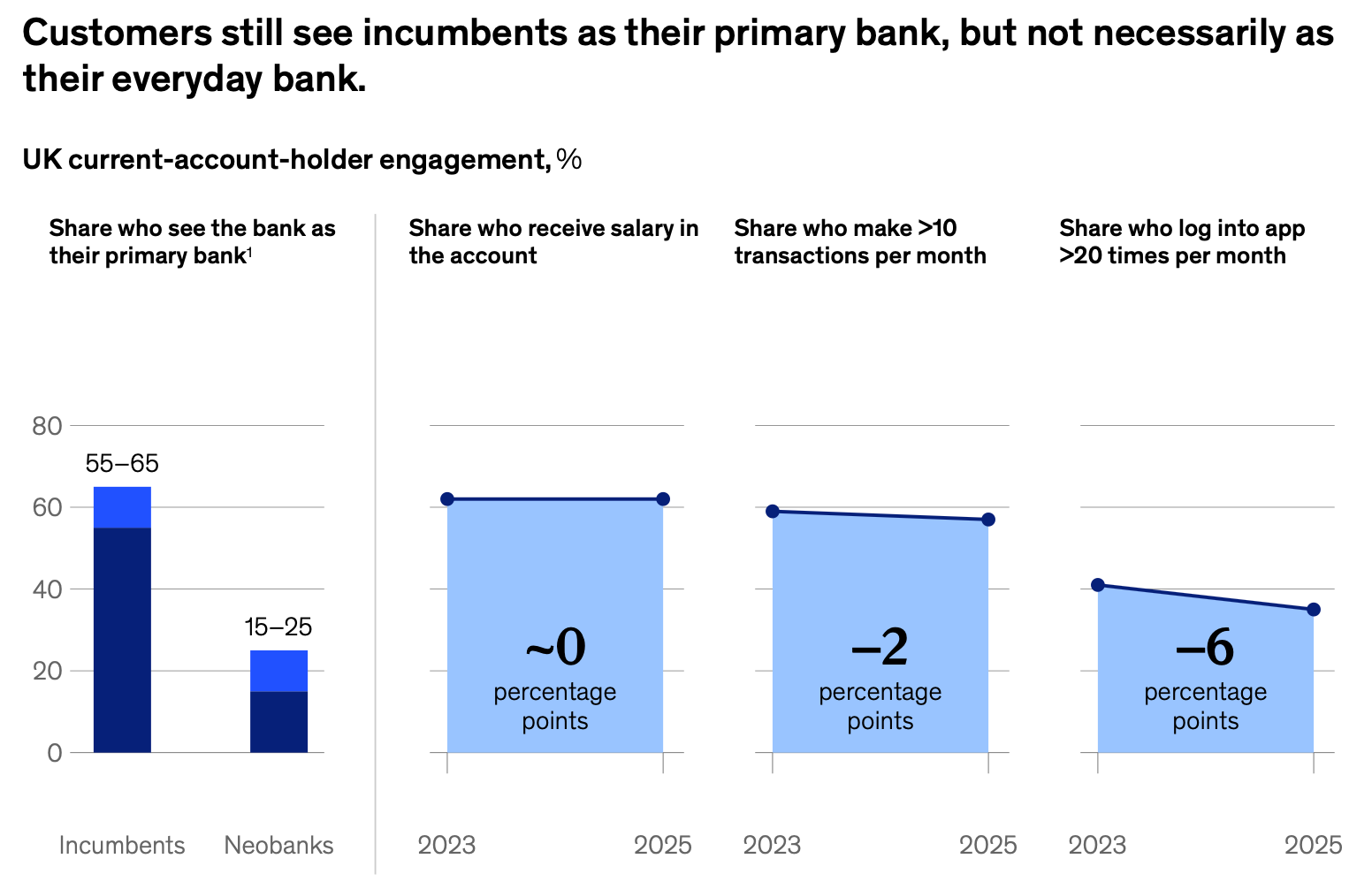
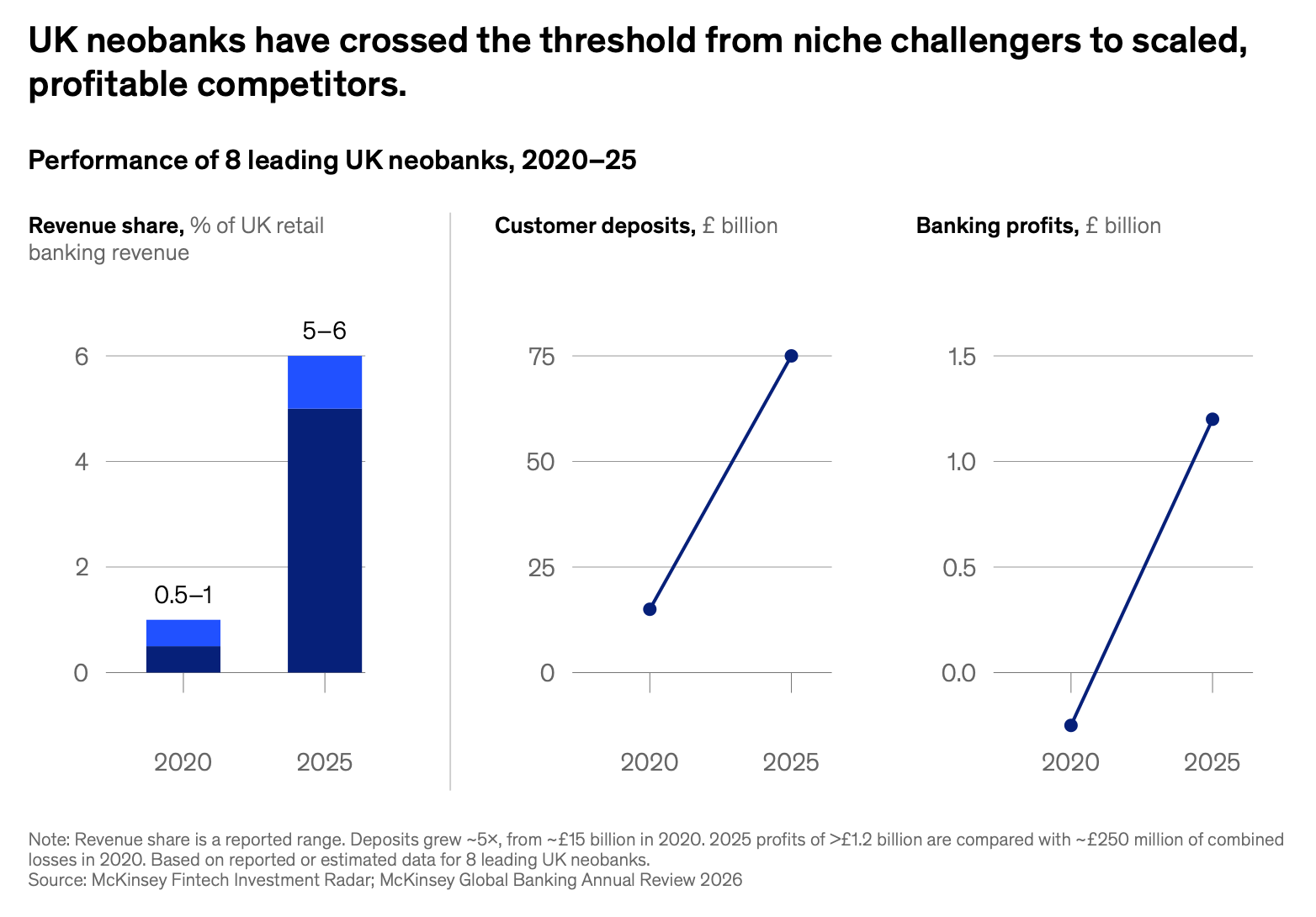
The primacy paradox. Incumbents are still the self-reported primary bank for 55–65% of customers, against 15–25% for neobanks, and the share of customers receiving salary into their primary account was flat between 2023 and 2025. But transaction primacy fell about two percentage points and digital primacy (more than 20 app logins a month) about six. Neobanks and fintechs hold about 27% of all UK banking relationships, up from low single digits a decade ago. Eight leading UK neobanks went from 0.5–1% of retail banking revenue in 2020 to 5–6% in 2025, grew deposits roughly five times from about £15B to £75B, and turned about £250M of combined losses into more than £1.2B of profit. Revolut reports 75M users, 19% of whom call it their primary bank, up from 11% in 2023, and secured a full UK banking licence in March 2026. In commercial banking, corporates report reallocating 12–25% of their annual banking wallet each year, and more than 60% of UK commercial banking revenue already sits outside lending.
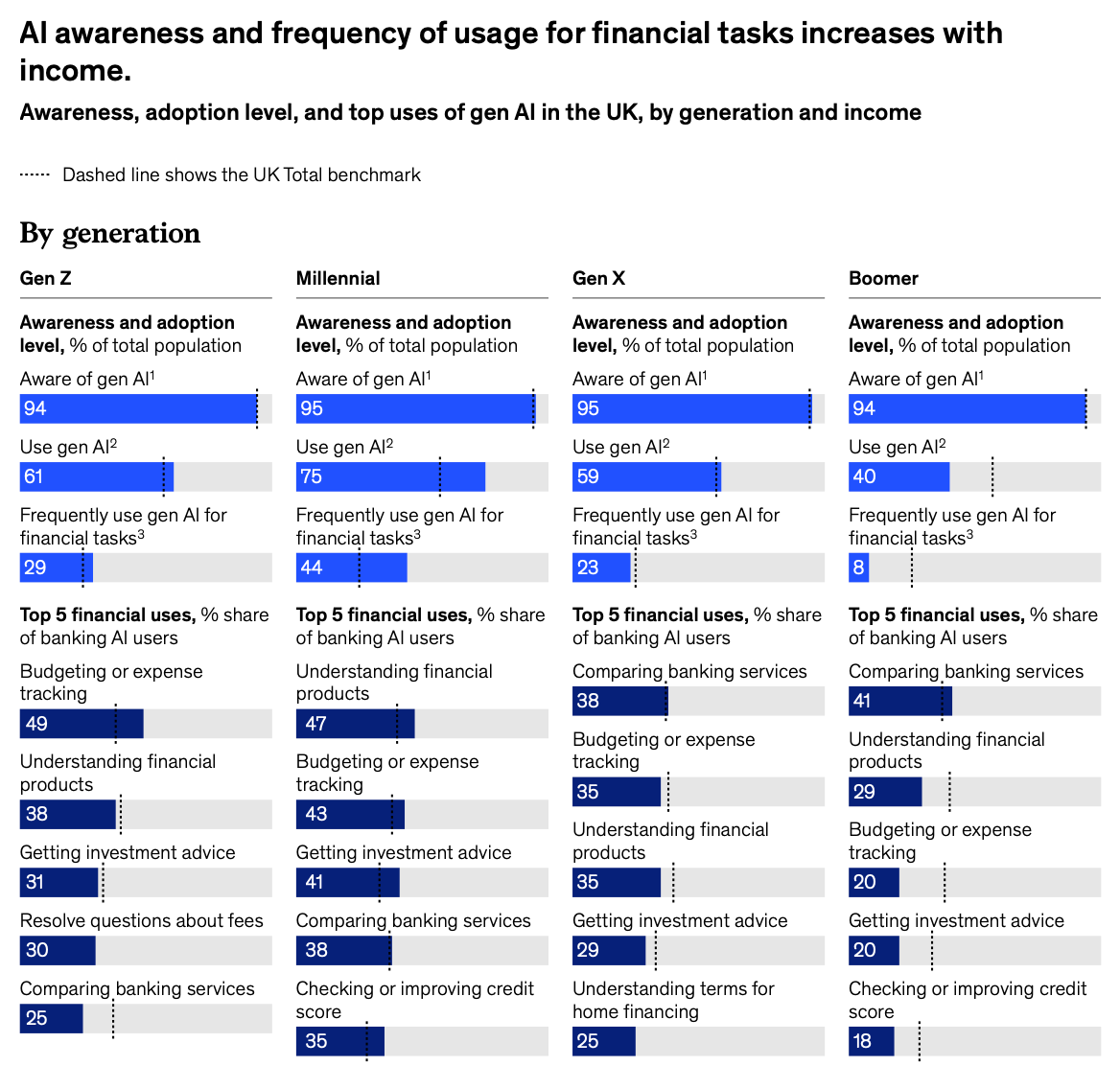
The AI window. 57% of UK consumers use AI tools about three years after launch; mobile banking took roughly a decade to reach the same share. 25% of UK consumers use gen AI at least monthly for financial tasks, 59% among high-income individuals. 71% of UK banking AI users go to general-purpose tools such as ChatGPT and Gemini for financial tasks, against 45% who use a bank chatbot. If 5–10% of balances moved to higher-yield accounts through agentic sweeping, deposit profits could fall 20% or more; McKinsey puts unaddressed disintermediation at about $170B, or 9%, of global bank profit pools over the decade. Trust is the counterweight: 64% of UK AI users would trust their primary bank most to offer AI services, against 16% for a large technology company and 8% for an independent fintech, but 49% would take a third-party financial AI service if their bank offered none.
Race one, customers and deposits. The prescription is an app that is a daily habit (cash-flow insights, subscription and duplicate-charge detection, life-event prompts), a loyalty or subscription mechanism with a defined role by segment (Revolut’s subscriptions are 16% of group revenue, growing 67% a year), and an in-house conversational agent plus generative-engine optimisation so the bank’s products show up when customers ask AI for advice. On deposits, £500B–£700B of mass and affluent savings could migrate into investments over the decade, out of a UK cash pile above £2T; seven million adults hold £10,000 or more entirely in cash and only about 9% of adults received regulated advice last year, against a third in the US. Wealth is the fastest-growing retail pool at about 7% a year, while savings revenue is declining.
Race two, the commercial transaction layer. 67% of large corporates cite transaction banking as a primary reason to engage their bank; execution speed and certainty rank in the top three reasons to choose a primary bank, behind only price. Adyen, Revolut Business, Stripe, Wise, Tide and embedded-finance platforms are moving in between banks and their business customers, and Monzo Business reached one million customers in six years. The report’s priorities: win businesses at formation, treat payments, FX, trade and treasury flows as strategic assets, build a dedicated midmarket model, and organise coverage around growth sectors and trade corridors. The roughly £250B of undrawn facilities UK banks provide is the lever to win execution flows.
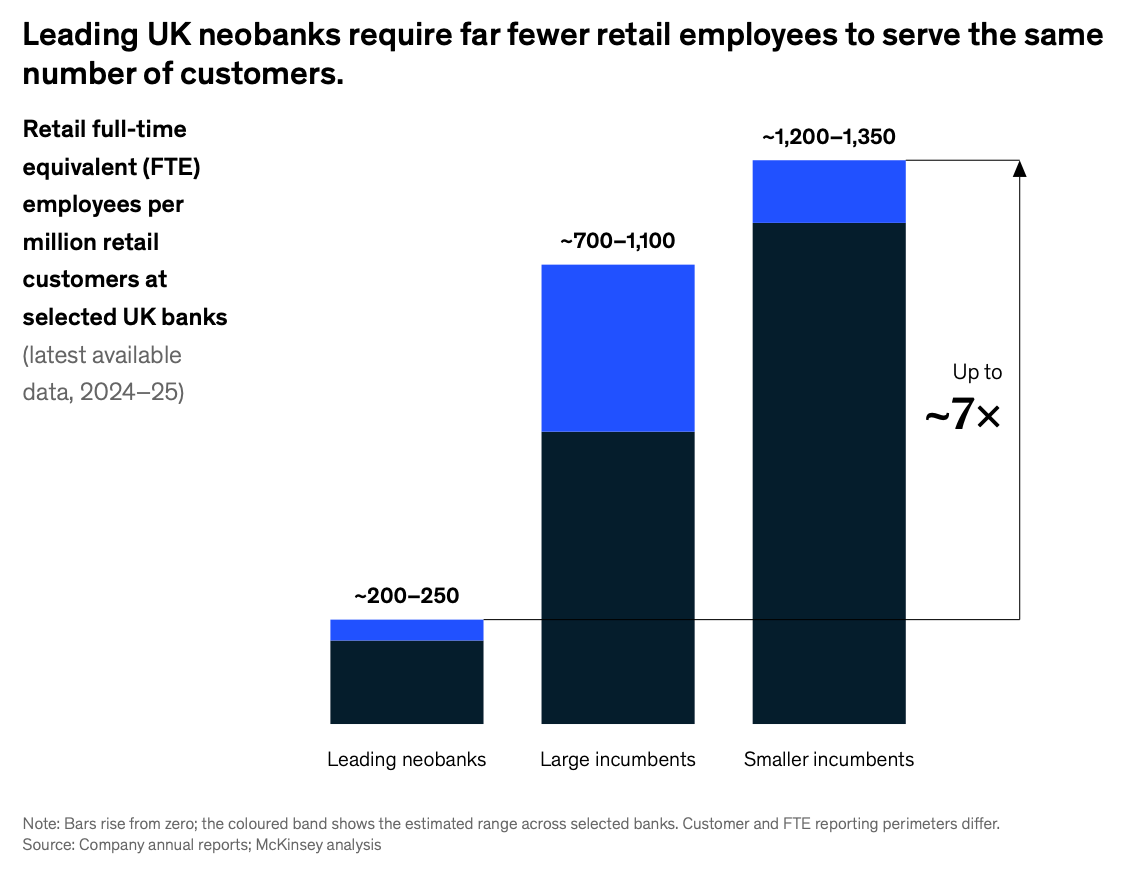
Race three, the cost base. Leading neobanks run on about 200–250 retail employees per million customers, against 700–1,100 for large incumbents and 1,200–1,350 for smaller ones, up to seven times more. Revolut nearly tripled its customer count while cutting cost to serve from about £25 per customer in 2022 to about £21 in 2025. Commercial relationship directors spend 65–75% of their time on non-sales work, and UK branches make around 43 core sales per employee a year against about 70 in Europe. Gen AI as a copilot lifts productivity perhaps 1.2 times; agentic operating models could cut European cost-to-income ratios by 15–20%. Where banks rewired one frontline workflow end to end, cost to serve fell 20–40% and each banker recovered 10–12 hours a week. Lloyds ran about 50 gen AI use cases in 2025 for roughly £50M of reported benefit and targets £100M in 2026; NatWest launched the first UK bank app inside ChatGPT.
The read. The number that matters is 71%: the share of UK banking AI users who already take financial questions to ChatGPT or Gemini rather than to their bank. Incumbents keep the salary and the trust (64% would prefer their bank’s AI), but the interface where decisions are made is drifting outside the bank, and the report’s own numbers say the customers who protected banks through the mobile cycle are using gen AI at nearly the same rate as their children. The balance sheet is a utility without engagement; the engagement is being won by companies that serve a million customers with 200 people. This week shows both responses. J.P. Morgan said outside AI agents cannot act on retail accounts, American Express published a framework to authenticate purchase intent before an agent pays, and Visa won approval to prepare domestic clearing in China: incumbents setting the terms of access. On the other side, Mollie is offering up to €50M in equity to a founding team to build a banking layer for agents, Fragment raised $12M for agent-ready ledgers, Matters raised $5M for an AI-native consumer bank in Stockholm, and Payward is buying an EU-licensed bank so Kraken’s parent can take deposits and lend. Watch whether UK incumbents put a bank-owned agent in front of customers before the 49% who would accept a third-party service get used to one.
The week in six stories
Ramp raises about $1.85B led by Dragoneer and Thrive Capital at a $60B pre-money valuation. Bloomberg reported the round on 9 October; Founders Fund also wrote a large cheque. It comes four months after a $750M round at $44B in June and closes talks first reported in September. Ramp said in June it worked with 70,000 businesses, and Bloomberg put annualised revenue above $1.5B at the time; its closest rival, Brex, sold to Capital One for $5.15B earlier this year.
OPay files for a New York IPO as Standard Bank commits up to $200M. The Nigeria-focused fintech applied to list American depositary shares on the NYSE as OPAY, with Citigroup, Deutsche Bank, CICC and Standard Bank representing the underwriters. Stanbic Africa Holdings signed a private placement capped at the lowest of $200M, 0.98% of Standard Bank’s qualifying regulatory capital or a 4.99% stake at the IPO price. The filing shows revenue of $467.1M and net income of $90.9M in the first half of 2026, and 50.1M monthly active users at the end of July; Nigeria is 88% of revenue, and a secondary Lagos listing is planned.
ID Finance raises €545M in debt and equity to scale Plazo in Spain. Spice Expeditions, WashU, Kingsway Capital and i80 Group took part; the split between debt and equity was not disclosed. Plazo, the Barcelona company’s consumer app for payments, rewards and short-term credit, tripled its loan portfolio in 2025 and reached profitability, co-founder Alexander Dunaev said.
Airtel Money starts trading in London at a £5.3B valuation. The offer price of £1.96 a share values the mobile money business at about $7B, below the $8–9B reported when the listing was announced in September. The deal is entirely secondary: existing shareholders including The Rise Fund, Qatar Holding, Mastercard and Chimetech sold 270M shares for about £529M, with a 27M-share over-allotment option; Airtel Africa stays majority owner and the free float is about 16.5%. Conditional dealing started on 9 October, unconditional on 14 October; Airtel Money serves about 53M users across 13 markets.
Payward, the parent of Kraken, agrees to buy Lithuania’s Saldo Bank. Saldo Bank is licensed by the European Central Bank and regulated by the Bank of Lithuania, serves Lithuania, Finland, Sweden and Germany and holds a Dutch passport; terms were not disclosed and closing is expected in 2027. The licence is meant to let Payward Banking, which has originated more than $2B in loans and holds a Federal Reserve limited-purpose master account and an Irish e-money licence, offer deposits, lending and card issuing in Europe. The same week Payward won full market approval from Dubai’s VARA and said Kraken will launch in the UAE in the coming weeks.
LSEG confirms talks to buy Octus from Permira for about $3.5B. The exchange group said no final agreement has been reached after Reuters and Bloomberg reported the discussions. Octus, founded in 2013 by CEO Kent Collier and based in New York, sells credit intelligence and workflow tools to buy-side firms, banks and law firms, with a position in private and illiquid credit; Permira bought a controlling stake from Warburg Pincus in 2022 at a $1.3B valuation. LSEG shares fell about 4.7% on the day.
Also: J.P. Morgan blocks outside AI agents from acting on retail customers’ accounts; Mollie offers up to €50M in its own equity to a founding team that builds a banking layer for AI agents; Berkshire Hathaway invests another $330M in Bending Spoons at $33 a share, taking its stake to 4%; Mastercard and BVNK launch a single API for fiat and stablecoin accounts; Causa Prima raises a $20M seed led by Base10 three months after its pre-seed; Zippy raises a $20M Series C from Saluda Grade; Intuit agrees to acquire Sequence; Visa wins approval from the People’s Bank of China to prepare a domestic card clearing business; Upgrade applies for a Nevada industrial bank charter.
Funds. Nine new vehicles this week: Sprints (€725M fifth fund, more than half deployed), Union Square Ventures ($900M across a $500M early-stage fund and a $400M opportunity fund), Oraseya Capital (fund doubled to AED1B, about $272M, maximum cheque raised to 6M),CascadorandSterlingBank(200M stated size for an SME credit backstop fund in Nigeria, capital still to be raised), 49 Palms Ventures ($100M debut fund, co-investing in AI founders), Gaius Capital (€50M debut fund at hard cap plus a €6M co-investment vehicle, succession in DACH insurance and financial services), Antares Ventures (more than $50M at second close of a $100M deep-tech fund in Singapore), Monte Carlo Capital (€13M first close of Fund II, target €26M) and the Refugee Venture Fund (£300K initial capital with Atomico, ahead of a planned £10M fund).
All rounds
Equity
Archa — A11MequityandaA50M debt facility, business credit without personal guarantees, Australia
Zippy — $20M Series C from Saluda Grade, manufactured housing lending, US
Fragment — $12M Series A led by FirstMark, ledger and financial infrastructure for AI agents, US
Fission — $10M Series A led by Pantera Capital, faster exits for tokenised fund investors, US
Matters — $5M pre-seed led by Jakob Johansson, AI-native consumer bank, Sweden
Neonomics — $4M from existing shareholders, open banking payments and data, Norway
Qippay — NZ$5M from All Roads Wholesale Fund for a 25% stake, open banking payments, New Zealand
Debt and credit
VC funds
Market news
AI agents and banks
Stablecoins, crypto and tokenisation
Rain launches embedded stablecoin wallets at the centre of its payments platform
Cocos spins out Cocos Crypto as a standalone app as it turns into a bank in Argentina
M&A and capital markets
LSEG is in talks to buy credit intelligence provider Octus from Permira for about $3.5B
Berkshire Hathaway invests another $330M in Bending Spoons at $33 a share, taking its stake to 4%
AvaTrade agrees to acquire the majority of FXCM Group’s business and brand
Luno acquires Kenyan cross-border payments startup GTXN to own licensed rails into emerging markets
Licensing, regulation and expansion
Visa wins approval from the People’s Bank of China to prepare a domestic card clearing business
Upgrade applies for a Nevada industrial bank charter to launch Upgrade Bank
India delays its UPI merchant fee after pushback from retailers
Pliant secures FCA authorisation as an Electronic Money Institution for its UK subsidiary
Revolut launches its own mobile plan in Germany at €14.99 a month, its fourth telecoms market
Hercle registers with FINTRAC in Canada, its first regulatory footprint in the Americas
Founders to watch
Companies I’ve been talking with this week that I find interesting
Out of It, Inc — Modern accounting for SMBs and accounting firms — books, bank feeds, invoicing, practice management, messaging, and a built-in marketplace in one login (US).
OvrumPay — OVRUM Pay helps small businesses sell, accept payments, and access their money faster—all from their iPhone (US).
RevSystem — RevSystems is a self-service AI phone-agent platform that qualifies callers using business-defined rules, then connects, books, or captures the next step (US).
Let me know if you want to have a chat with them, always happy to make an intro.
Raising now
Space for GPs and solo GPs launching funds. Not paid. If you’re raising and want to be listed, message me on LinkedIn.
Parallax Ventures — fintech, LatAm. Raising Fund II. [link] · gennari@parallax.vc
Founder Factor — YC-focused. Just closed investments in YC W26 and is expanding the current vehicle to double down on the batch. [link]
RedFish Capital Partners — private equity, Italian SMEs in growth and mature phases. €200M+ AUM. Raising a new AIF with a soft commitment from the European Investment Fund. redfish.capital · investor.relations@redfish.capital
Nothing here is investment advice.
Events, next 30 days
Money20/20 USA — Las Vegas, 18–21 Oct
MERGE Madrid — Madrid, 27–29 Oct
Hong Kong FinTech Week — Hong Kong, 2–6 Nov
Africa Stablecoin Summit — Johannesburg, 12–13 Nov
Solana Breakpoint — London, 15–17 Nov
Singapore FinTech Festival — Singapore, 18–20 Nov
Later: Fintech Nerdcon, San Diego (19–20 Nov) · Bitcoin MENA, Abu Dhabi (7–8 Dec) · Abu Dhabi Finance Week (7–10 Dec) · TOKEN2049 Dubai (21–22 Apr 2027) · Money20/20 Asia, Bangkok (27–29 Apr 2027)
Want an event listed or sponsored? DM me.
Previous edition: Weekly update #153